GB200 Superchip Now on Vast.ai: What It Is and What It's For

The NVIDIA GB200 Grace Blackwell Superchip combines two GPUs and a CPU in a single module. Now available on Vast.ai in a four-GPU server, it offers developers a new GPU rental option that supports increasingly complex AI systems.
Here's a closer look at the hardware and what it's built to do.
What Is the NVIDIA GB200 Superchip?
The GB200 is NVIDIA's Blackwell-based computing platform with two B200 GPUs and one Grace CPU.
Each GB200 Superchip includes:
- Two Blackwell B200 GPUs that provide accelerated computing power for AI training and inference, with up to 384 GB of combined HBM3e memory and 16 TB/s of combined memory bandwidth.
- One Grace CPU to handle data preprocessing and other tasks alongside the GPUs. It's an Arm-based processor with 72 cores and up to 480 GB of LPDDR5X memory.
- NVLink-C2C to connect the CPU and GPUs with up to 900 GB/s of bidirectional bandwidth.
Unlike the PCIe connections typically used between CPUs and GPUs, NVLink-C2C is a high-speed chip-to-chip link that enables memory coherence across the Grace CPU and Blackwell GPUs. This means the CPU and GPUs can work on the same data without constantly having to copy it back and forth.
The CPU's LPDDR5X memory has lower bandwidth than the GPUs' HBM3e memory, but its massive capacity makes it useful as an additional tier for workloads that surpass the GPUs' available HBM.
The result is an architecture that reduces communication bottlenecks and expands the memory resources available for demanding AI and high-performance computing (HPC) workloads.
Scaling Blackwell: GB200 Superchip vs. NVL4 vs. NVL72
The GB200 Superchip is a building block for even larger NVIDIA GPU systems. Here's an overview of how the single module compares with two other configurations from NVIDIA, the GB200 NVL4 and NVL72:
| SPECIFICATION | GB200 SUPERCHIP | GB200 NVL4 | GB200 NVL72 |
|---|---|---|---|
| Blackwell GPUs | 2 | 4 | 72 |
| Grace CPUs | 1 | 2 | 36 |
| Form factor | Single module | Multi-GPU system | Rack-scale AI supercomputer |
| GPU memory (HBM3e) | Up to 384 GB | Up to 768 GB | Up to 13.4 TB |
| HBM3e memory bandwidth | 16 TB/s | 32 TB/s | 576 TB/s |
| GPU-to-GPU NVLink bandwidth | 3.6 TB/s | 7.2 TB/s | 130 TB/s |
| CPU memory (LPDDR5X) | Up to 480 GB | Up to 960 GB | 17 TB |
| CPU bandwidth | Up to 512 GB/s | Up to 1 TB/s | 14 TB/s |
| NVFP4 Tensor Core* | 40 | 20 PFLOPS | 80 | 40 PFLOPS | 1,440 | 720 PFLOPS |
Specification in sparse | dense.
The GB200 NVL4 connects four Blackwell B200 GPUs and two Grace CPUs – essentially two superchips in one system. It's built for workloads that need more than two GPUs but not a full rack. This is the configuration available to rent on Vast.ai.
The GB200 NVL72 scales the same design to a liquid-cooled rack of 72 GPUs and 36 CPUs, with a fifth-gen NVLink domain allowing all 72 GPUs to communicate at ultra-high bandwidth like a single, massive accelerator. It's a substantial piece of infrastructure. A fully loaded rack weighs about 3,000 pounds (1.36 metric tons) and draws more than 120 kW of continuous power, so it's built for dedicated data center deployments.
The NVL72 represents the extreme end of rack-scale AI factories, while the NVL4 serves as a more compact and versatile high-density configuration. But what makes the NVIDIA GB200 useful in practice?
NVIDIA GB200 Superchip Use Cases
The GB200 is best suited for big jobs that are limited by memory capacity or by communication between processors. When it comes to the four-GPU NVL4 configuration, common use cases include:
Large-model inference. Some large models, like the 753B-parameter Mixture-of-Experts model GLM 5.2, can require several GPUs just to hold their weights in memory. When this happens, the NVL4's high-bandwidth GPU-to-GPU links help reduce communication overhead.
Long contexts and high concurrency. The key-value (KV) cache grows with context length and request volume. The GB200's large memory capacity helps with both, and its fast CPU-GPU link can support offloading part of the cache to CPU memory.
Training and fine-tuning large models. The NVL4's four GPUs combine their HBM3e capacity to accommodate larger models and batch sizes, and high-speed interconnects keep data moving quickly between cards during distributed training.
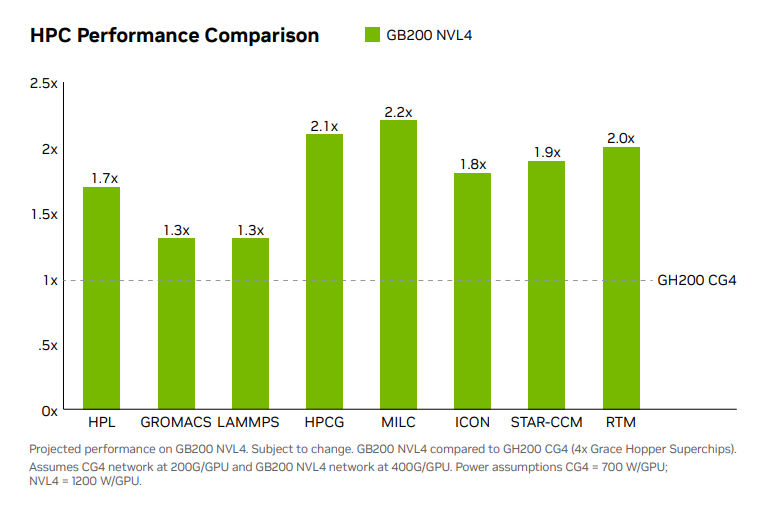
Converged HPC and AI workloads. NVIDIA states that the GB200 NVL4 is "purpose-built for scientific computing" and provides up to 2x faster high-performance compute over the prior generation.
Should You Pick the NVIDIA GB200 for Your Workload?
If your model fits comfortably in single-card memory, then a standalone H100, H200, or B200 may be the better choice; they're often more affordable to rent and avoid the communication overhead of splitting a model across multiple GPUs.
Choose the GB200 for its specific strengths – memory capacity and GPU-to-GPU bandwidth – when you actually need them.
Find the Right GPU on Vast.ai
With NVIDIA GB200 GPUs now live on Vast.ai, developers have even more flexibility to match powerful compute resources to their specific workloads and budgets.
Ready to get started? Vast.ai lets you compare GPUs, check real-time platform pricing, estimate your GPU costs with our pricing calculator, and choose the configuration that best meets your needs. With per-second billing, you pay only for the compute you use, with no long-term commitments.
Browse available GPU instances on Vast.ai today.