NVIDIA GeForce RTX 5090: Everything You Need to Know
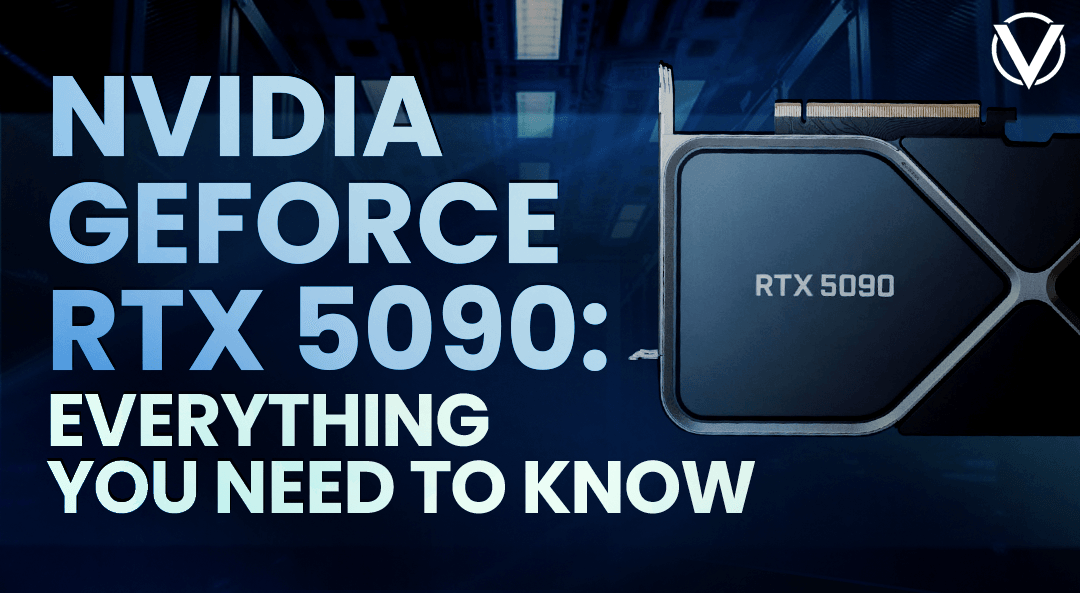
The NVIDIA GeForce RTX 5090 launched in January 2025 – and over a year later, it's still surprisingly difficult to get your hands on one.
Despite retail prices officially starting at $1,999 MSRP, limited availability and strong demand from both gamers and AI developers means stock sells out quickly and real-world pricing has pushed higher.
As NVIDIA's most powerful consumer GPU, the RTX 5090 is undoubtedly an impressive machine. Is it worth the steep price tag, though? That depends on more than just raw power – let's take a look.
RTX 5090: The Consumer Powerhouse
For starters, here are some of the official specs for the RTX 5090:
- Architecture: Powered by NVIDIA's cutting-edge Blackwell architecture.
- Gaming Chip: Featuring the next-gen GB202 gaming chip.
- Memory: 32GB of GDDR7 memory with a blazing-fast 1,792GB/sec bandwidth, supported by a super-wide 512-bit memory interface for even faster data transfer.
- CUDA Cores: 21,760 cores for high-performance graphics workloads, complementing the 680 Tensor cores that accelerate AI inference and training.
- L2 Cache: Expanded to 98MB, up from 73MB on the RTX 4090, improving memory efficiency and reducing latency.
- Display Support: PCIe Gen 5 with DisplayPort 2.1b connectors supporting up to 8K at 165Hz.
- Power Requirements: 575W total graphics power (TGP), with a 1000W power supply recommended for optimal performance.
Another bonus: the RTX 5090 has a redesigned Founders Edition with a three-slot design and a dual flow-through fan configuration – so it's more compatible with tighter builds, a remarkable shift from its predecessors.
For reference, here's a quick overview of the RTX 5090:
| Spec | RTX 5090 |
|---|---|
| CUDA Cores | 21,760 |
| Ray Tracing Cores | 170 (4th-gen) |
| Tensor Cores | 680 (5th-gen) |
| Base Clock | 2,017 MHz |
| Boost Clock | 2,407 MHz |
| L2 Cache | 98,304KB |
| ROPs | 176 |
| VRAM | 32GB 28Gbps GDDR7 |
| VRAM Interface | 512-bit |
| Memory Bandwidth | 1,792 GB/s |
| Interface | 16x PCIe 5.0 |
| Power Connectors | 1 x 16-pin (PCIe 5.0 / ATX 3.0) native connector; includes 4 x 8-pin adapter |
| Total Graphics Power (TGP) | 575W |
(For more specifications – and to see how the RTX 5090 stacks up against its younger siblings in the RTX 50-series lineup as well as the RTX 4090 – check out the chart at the bottom of this page.)
RTX 5090: AI and Professional Workloads
The RTX 5090 is well-suited for high-performance AI and professional workloads. Its 680 Tensor cores and 32GB of GDDR7 memory efficiently accelerate deep learning, 3D rendering, and other compute-intensive tasks. With 98MB of L2 cache and a 512-bit memory interface, the RTX 5090 delivers faster data access and reduced latency – crucial for AI training, scientific computing, and content creation.
The 5th-gen Tensor cores boost AI inference efficiency in frameworks like TensorFlow and PyTorch, while 4th-gen RT cores enhance real-time ray tracing for animation, visual effects, CAD work, and more.
For demanding AI and video workloads, the RTX 5090 more than meets the challenge. In Procyon's AI XL (FP16) test, the RTX 5090 was 40% faster than the RTX 4090, and in PugetBench's DaVinci Resolve video processing test, it was 12% faster.
Next-Gen Gaming Features
The biggest leap in technology for this GPU comes from DLSS 4's new Multi Frame Generation, an AI-driven frame interpolation technique exclusive to the RTX 50 series. It uses AI to generate up to three additional frames between traditionally rendered ones, significantly boosting frame rates with minimal visual artifacts.
Further, the RTX 5090 introduces a range of AI-driven enhancements in what's called neural rendering, designed to push in-game realism to new levels. RTX Neural Shaders improve texture compression and deliver film-quality lighting and shading in real time, while RTX Neural Faces uses generative AI to create lifelike skin, hair, and facial details.
Building on the power of DLSS 4, these neural rendering techniques integrate directly into the graphics pipeline, leveraging NVIDIA’s Tensor cores to enhance visual fidelity. As game support continues to expand, these technologies demonstrate the potential for deeper shadows, realistic translucency in materials, and an overall richer environment.
Another breakthrough is Mega Geometry, a feature that uses RT cores to significantly boost the number of triangles in ray-traced scenes. This allows game engines to maintain full geometric detail without sacrificing performance, resulting in more realistic object depth, shadows, and fine details.
The above features position the RTX 5090 as a powerhouse for next-generation gaming visuals... but there's a catch.
Caveat: Performance Claims vs. Real-World Results
The way that NVIDIA presents its performance numbers can be misleading. The company leans heavily on Multi Frame Generation-boosted FPS (frames per second) to compare these new GPUs against older ones.
Frame Generation and Multi Frame Generation (MFG) are powerful tools, but they aren't universal fixes. Their impact varies by game – some titles see massive FPS gains with little visual trade-off, while others may introduce artifacts or latency.
In addition, not all games will support these features, as DLSS adoption depends on individual developers. A GPU's raw performance still matters. MFG-inflated benchmarks can make performance gains seem more significant, but Frame Generation still needs a strong base frame rate to be effective. In CPU-limited games, or titles that don't support DLSS 4, the real-world performance gap may be far smaller.
Ultimately, while the RTX 5090 excels at AI-driven rendering, real-world results will depend on game support and how well these features are implemented.
Worldwide RAM Shortage and Price Increases
Due to explosive growth in AI data centers and tech giants continuing to invest heavily in AI accelerators, there's an ongoing worldwide RAM shortage that shows no signs of slowing down. Some forecasts predict that shortages could last until 2030.
It's no surprise that high demand and limited supply lead to rising prices. With the RTX 5090, though, there may be another factor at play. DeepSeek's rapid rise in popularity has sparked a huge surge in demand for NVIDIA's gaming GPUs in China, as these cards can be repurposed to run DeepSeek's AI models – and provide a workaround for U.S. export restrictions on advanced GPUs.
See our guide on how to run DeepSeek R1 on a GPU cloud.
With a global shortage of RAM and both gamers and AI developers vying for the same hardware, the strain on supply could push RTX 5090 prices even higher in the near future. Most buyers currently face inflated market prices ranging from $2,500 to over $4,000. And with NVIDIA set to increase prices further on account of VRAM sourcing costs, those numbers could skyrocket to over $5,000.
Final Thoughts: The Power of the RTX 5090 – Without the Hassle
The RTX 5090 remains the most powerful consumer GPU available today. For cutting-edge 4K gaming with DLSS 4 and Multi Frame Generation, as well as demanding AI and professional workloads, it delivers unmatched performance in a relatively accessible package.
At the same time, it may only be worth purchasing if you really want the best of the best and you're willing to shell out for it. The high price tag makes it a significant investment for the average user.
In the meantime, why wait? Skip the delays and high costs – rent an RTX 5090 on Vast.ai for instant access to top-tier performance. Given its limited availability and its 575-watt power draw, our affordable rental options are the most practical way to access the RTX 5090's full potential without the upfront investment.
Try the 5090 GPU for yourself today.
Additional Specifications:
Spec | RTX 5090 | RTX 5080 | RTX 5070 Ti | RTX 5070 | RTX 4090 |
|---|---|---|---|---|---|
Architecture | GB202 | GB203 | GB203 | GB205 | AD102 |
| VRAM | 32GB GDDR7 | 16GB GDDR7 | 16GB GDDR7 | 12GB GDDR7 | 24GB GDDR6X |
VRAM Speed | 28Gbps | 30Gbps | 28Gbps | 28Gbps | 21Gbps |
VRAM Bus Width | 512 | 256 | 256 | 192 | 384 |
Bandwidth | 1792GB/s | 960GB/s | 896GB/s | 672GB/s | 1.01TB/s |
Streaming Multiprocessors (SMs) | 170 | 84 | 70 | 48 | |
Tensor Cores | 680 | 336 | 280 | 192 | 512 |
Ray Tracing Cores | 170 | 84 | 70 | 48 | 128 |
Boost Clock | 2407 MHz | 2617 MHz | 2452 MHz | 2512 MHz | 2520 MHz |
Total Graphics Power (TGP) | 575W | 360W | 300W | 250W | 450W |
Recommended Power Supply | 1000W | 850W | 750W | 650W | 850W |
Launch Date | Jan. 30, 2025 | Jan. 30, 2025 | Feb. 20, 2025 | Mar. 5, 2025 | Sept. 20, 2022 |
Launch Price | $1,999 | $999 | $749 | $549 | $1,599 |
Post originally written March 7, 2025, updated May 21, 2026.